
Time Management Strategies For Moms Building A Side Hustle
Time management for moms building a business can be a touchy subject because most of us are hoping for the same thing.
We want the planner, the system, the routine, the app, or the schedule that finally fixes the problem.
We want the magic bullet that makes our time feel manageable.
But the hard truth is that no one else has your exact life.
No one else has your exact kids, home, marriage, work schedule, energy level, responsibilities, goals, personality, or season of life. There will always be some little nuance that makes someone else’s perfect system not quite work for you.
That can feel frustrating because most of us were trained to look for the right answer outside of ourselves. Follow the rules. Do what the expert says. Use the system exactly the way it was designed, and you’ll get the result.
But time management as a mom does not work that way.
You might find a planner you love. You might find a routine that helps. You might learn a method that gives you a better starting point. But you are probably not going to find a complete copy-and-paste system that works for your entire life without adjustment.
I would know. I’ve bought several promising ones that didn’t quite work out.
You have to learn how to build a system that works for you.
That is the real goal of this post.
I am going to give you guidelines, but I also want you to learn how to think through your own week. I want you to know how to look at your life honestly, keep what works, leave what doesn’t, and notice where the snags are so you can adjust instead of quitting.
Because if you are a mom trying to build a business, work toward a goal, or create something meaningful with limited time, you do not need a perfect schedule.
You need a flexible system that helps you keep making progress in the middle of your actual life.
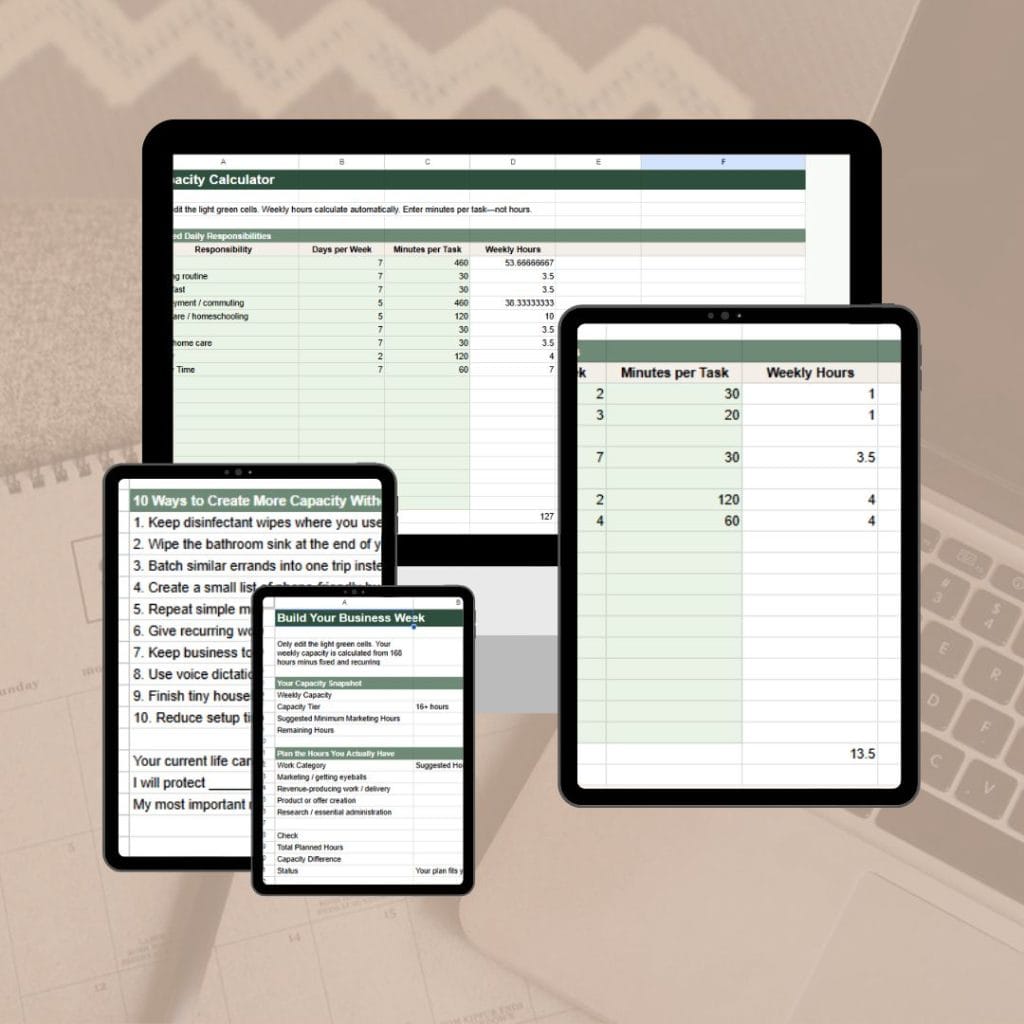
Wondering if you have time for a side hustle?
Get your free side hustle capacity calculator now!
Know What You Are Actually Working Toward
Before you can manage your time well, you need to know what you are trying to make room for.
This is the part a lot of people skip.
They jump straight into planners, schedules, routines, and task lists. But if you do not know where you are headed, you will have a hard time choosing tasks that actually matter.
You can stay busy all day and still not move your life forward.
That is why time management has to start with direction.
You do not need to have every detail of your life figured out. You do not need a perfect five-year plan. But you do need some idea of what you are trying to build, improve, protect, or change.
For example, one of my current personal goals is to get a little leaner physically. That means certain tasks have to fit into my real life. I need to track calories. I need to focus on getting enough protein. I need to get a walk in at least a few times a week.
Those are not random tasks. They connect to a specific goal.
I am also working on growing my Facebook page. I have reach goals I want to hit and a certain number of posts I want published by the end of the quarter.
Knowing that matters because it helps me choose the right tasks.
If I say I want to grow my page, but I never make time to write posts, schedule content, review what is working, or engage with people, then the goal is just a wish. It is not actually being supported by my week.
The same is true for you.
Maybe one of your goals is to start a side hustle.
Maybe you want to build a small business that fits into 10 to 15 hours a week.
Maybe you want to create something that gives your family more financial breathing room.
Maybe you want to save more money on groceries so your household has more margin.
Maybe you want to get healthier, simplify your home, or build a calmer family rhythm.
The exact goal is not the point.
The point is that you need to know what matters enough to receive your time.
So before you plan your week, ask yourself two questions.
First, what would make me feel like I had used my life well?
Not what would impress other people. Not what sounds good online. Not what someone else says you should want.
What would actually make you feel grateful, proud, and at peace when you look back?
Maybe it is being physically strong and healthy.
Maybe it is building income that gives your family more choices.
Maybe it is raising your kids with intention.
Maybe it is creating a business that serves people well.
Maybe it is building a home that feels steady instead of constantly chaotic.
Write those things down.
Then bring the timeline closer.
Where would you like to be in the next five years?
And based on that, what needs to happen in the next twelve months?
This is where you need to be honest and realistic. Moms are often working with interrupted time, limited energy, and a lot of responsibilities that do not disappear just because we have goals.
You may not move as fast as you wish you could.
But you will move a whole lot further if you are clear about where you are going.
Because once you know the bigger direction, your weekly planning gets easier.
You are no longer asking, “What could I do this week?”
You are asking, “What matters enough to make space for this week?”
That is a very different question.
Start With the Things You Cannot Control
Before you start planning business tasks, projects, goals, or even household routines, you need to get honest about the time that is already spoken for.
These are the things in your week where you do not get much say over the timing.
School drop-off. School pick-up. A part-time or full-time job. Church. Appointments. Practices. Meetings. Outside commitments. Anything that happens at a set time and cannot easily be moved.
Start by putting those into a calendar first.
You can use a printed hour-by-hour weekly schedule, Google Calendar, iCal, or whatever system you already like using. The tool does not matter as much as getting a clear visual picture of where your time is already committed.
Some people call these your “big rocks,” but I think of them more simply than that.
They are the first things you cannot control.
Mark them down first.
Once you do that, you can stop planning from the imaginary version of your week and start planning from the real one.
Then add the second layer: the things you have some control over, but still have to happen for life to function.
These are things like showering, meals, grocery shopping, getting kids ready, driving time, errands, basic house maintenance, and the regular responsibilities that keep your life moving.
You may not do all of these at the exact same time every week, but they still take time. And if you do not account for them, you will accidentally plan as if that time is available when it really is not.
This is where a lot of moms get discouraged.
It is not always that you planned badly. Sometimes you simply planned without counting the hidden time.
The drive time.
The transition time.
The time it takes to get kids out the door.
The time it takes to clean up after the thing.
The time it takes to mentally switch from one role to another.
Those pieces count.
So before you decide you are failing at time management, get the real shape of your week in front of you.
Not the ideal week.
Not the week someone on the internet told you to have.
Your actual week.
That is where flexible time management starts.
Learn to Spot the Pockets of Time You Cannot Plan For
This next part may feel a little impossible at first, because I am going to ask you to think through a “typical day.”
And if you are a mom, you already know the problem with that.
Most of us do not really have typical days.
Especially when you are living with kids, interruptions, changing schedules, and a home that does not run like a business office.
So instead of trying to create one perfect daily schedule, I want you to start noticing what tends to happen in a typical week.
What rhythms show up over and over again?
Does your husband usually want to work on projects when he gets home?
Does your family tend to spend more time outside in the summer?
Are there evenings when your kids are happily occupied for a little while?
Are there pockets of time that appear, but not reliably enough to put them on a calendar?
Those moments matter.
For example, I typically make dinner somewhere around 5:30 or 6:00. But in the summer, my husband will often want to work on projects outside, take our son to the pond to fish, or do something before we fully settle into dinner.
Those are not clean, predictable work blocks.
But they are still small pockets of time.
And if I am prepared for them, I can use them.
Another example is when my son wants to play outside. He is still young enough that I need to keep an eye on him, but as long as I am sitting nearby and talking to him here and there while he plays in the dirt, he is happy.
That is not the time for deep work.
But it can be a great time for phone-friendly tasks.
I can outline an idea. Respond to a message. Brainstorm titles. Review a draft. Make a quick note. Sort through a task list. Plan the next step of a project.
The key is that I have to be ready for that kind of time before it shows up.
This is one of the skills moms building businesses need to develop: the ability to spot the little pockets of time you cannot perfectly plan for, but can still use wisely.
I am not talking about squeezing productivity out of every second of your life until you are exhausted. That is not the goal.
The goal is to stop wasting your best work time on tasks that could have been done in the margins.
If you have one strong hour at your computer, you do not want to spend that hour scrolling, sorting random notes, or trying to remember what you were supposed to do next.
You want to use that focused time for the tasks that actually need your best attention.
So think through your days, weeks, and even the different seasons of your life.
Where do small pockets of time tend to show up?
Maybe it is while your kids play outside.
Maybe it is during sports practice.
Maybe it is in the school pickup line.
Maybe it is while dinner is in the oven.
Maybe it is while your child is doing independent play.
Maybe it is during those odd 15 minutes when everyone is occupied, but you cannot fully leave the room.
Write those down.
Then make a second list of the kinds of tasks you could do in those moments.
Not every task fits every pocket.
Some tasks need a computer.
Some need quiet.
Some need creativity.
Some only need your phone.
Some only need five minutes of clear thinking.
When you know the difference, you can make much better use of the time you actually have.
That is how flexible time management works.
You are not trying to force every part of your life into a perfect schedule.
You are learning how to recognize the time you do have, prepare for it, and use it in a way that supports the bigger goals you are trying to build.
How to Fit Business Tasks Into Your Already Busy Life
Once you can see the real shape of your week, the next question is obvious.
How are you actually supposed to fit business tasks into an already busy life?
Because when you are a mom with kids, responsibilities, interruptions, meals, appointments, errands, and a home to manage, building an income stream can feel almost impossible.
You may have this deep desire to build something that gives your family more options, but when you look at your actual week, it can feel like there is no way to make it happen.
Before we talk about where business tasks fit, I want to say this clearly: make sure the business you are building has the possibility of fitting into the life you actually have.
[NOTE TO SELF: Link to future/supporting post about choosing a flexible business or income stream that fits your current season.]
Flexible income streams are one of the most valuable assets for busy moms because they can bend around family life better than a business that requires constant availability, strict hours, or a schedule you cannot realistically maintain.
Your business still has to require work. There is no way around that.
But it should not require a version of your life that does not exist.
Once you know the business can realistically fit your season, make a list of the business tasks that matter most.
And by “matter most,” I mean the tasks that are most directly connected to visibility or income.
Those are the two big things to look for:
What helps people find your business?
What helps your business make money?
I know organizing, tweaking, researching, color-coding, and cleaning up your systems can feel important. And sometimes those things do need to happen.
But they do not always get you eyeballs.
And if you have no eyeballs, you have no income.
People have to find your business before they can buy from you.
So when you are working with limited time, you have to be honest about which tasks are actually moving the business forward and which ones only make you feel busy.
Make a list of your business tasks in order of impact.
The tasks that are most likely to bring visibility, connection, leads, sales, or meaningful progress go at the top.
The tasks that feel useful but are not directly tied to results go closer to the bottom.
Then look at your day and ask where those higher-impact tasks could realistically fit.
Could you get up an hour before your kids?
Could you use nap time?
Could you use a quiet evening block a few times a week?
Could you trade time with your husband so you have one focused work block?
Could you protect one or two stronger work sessions each week for the tasks that actually need your full attention?
For me, I am usually up around 6:30 or 7:00, depending on how the night before went. That gives me about an hour to an hour and a half before my son is up.
I do my morning devotions first, and then whatever focused time is left goes toward the most important business task for that day.
Then, during nap time, I can either finish that task or move to the second most important thing.
Those are my desktop hours.
That means I try to save those blocks for the larger projects or the work that is best done at my desk. Writing. Editing. Planning content. Working on products. Reviewing strategy. Anything that needs more focus and fewer interruptions.
But not every business task needs a desk.
That is the next piece.
You also need a list of smaller business tasks that can be done from your phone or in short pockets of time.
These may still be important tasks, but they do not require the same level of focus.
Things like jotting down content ideas, replying to a thoughtful comment, outlining a post, checking a simple metric, making a quick note, brainstorming titles, or organizing tomorrow’s task list.
These are the tasks that can fit into the little pockets of time that show up during the day.
When your kids are playing outside.
When you are sitting in the car.
When you are waiting at an appointment.
When dinner is cooking.
When everyone is occupied for ten minutes, but you cannot fully leave the room.
So instead of having one giant business task list, create two lists:
Focused business tasks that need your better attention, your computer, or a larger block of time.
Small business tasks that can be done quickly, from your phone, or in the margins.
Then order both lists by impact.
That part matters.
Because the goal is not just to do more.
The goal is to use the right kind of time for the right kind of task.
Your focused time should not be wasted on low-impact work that could have been done from your phone.
And your small pockets of time should not be ignored just because they are not long enough for a big project.
This is how you begin fitting business into an already busy life.
Not by pretending you have unlimited time.
Not by forcing yourself into someone else’s perfect schedule.
But by knowing what matters, protecting your best work blocks, and being ready to use the small pockets when they show up.
Separate Maintenance Tasks From Progress Tasks
This is where opinions are going to differ.
But if you are trying to manage your home, raise your family, and build a business, you have to be honest about the difference between maintenance tasks and progress tasks.
Maintenance tasks are the things that keep life functioning.
Dishes. Laundry. Grocery shopping. Meals. Tidying. Errands. Basic household responsibilities.
They matter.
I am not saying they do not.
But progress tasks are different.
Progress tasks are the things that move your life toward the goals you said mattered to you. They are the tasks connected to your health, your business, your income, your family’s future options, or the projects that could actually change your life over time.
And if you constantly give your best time to maintenance, your progress tasks will always get the leftovers.
That is where a lot of women get stuck.
They stay busy all day. They work hard. They take care of everyone. They keep the house moving. But the things that would actually build the next version of their life never get protected time.
So when you are planning your week, I want you to think carefully about where your maintenance tasks belong based on your bigger goals.
For example, as I am writing this, I can see dishes in my sink from last night.
That is normal for us sometimes.
We tend to do things later in the evening as a family. We may be outside, working on projects, spending time together, or simply choosing to be present instead of immediately resetting the kitchen.
So I often let the dishes sit until morning.
Then, when my son is waking up and we are moving into breakfast anyway, I take care of them.
The dishes matter. They get done every day.
But they are not the most life-impacting task I could give my best quiet time to.
If I use my early morning focus time on dishes, then that time is gone. And for me, that is some of the best time I have for the work that can help grow my business.
This is not about letting your home fall apart.
My home is picked up every day. We keep things tidy as we go. I am not talking about living in chaos and calling it ambition.
I am talking about choosing the right time for the right kind of task.
Some tasks can be done while your kids are nearby.
Some can be done while you are talking to your family.
Some can be done during lower-energy moments.
Some can be done in the normal flow of the day.
But some tasks need your best focus.
Those are the tasks you have to protect.
So make a list of your regular maintenance tasks.
Then ask yourself:
Do these need my best quiet time?
Can they be done while my kids are awake?
Can they be done while I am already moving through the kitchen, laundry room, or errands?
Can they be batched?
Can they be done later without creating a true problem?
Then make a second list of your progress tasks.
These are the things tied to the goals you said mattered.
Writing the post.
Creating the product.
Recording the video.
Sending the email.
Going for the walk.
Tracking the food.
Reviewing the numbers.
Making the offer.
Doing the work that actually moves something forward.
Those tasks need first consideration when you are planning your best time blocks.
Not because dishes do not matter.
But because dishes will usually demand your attention eventually.
Your goals often will not.
Your business will not chase you down and remind you to grow it.
Your health will not automatically get better because you thought about it.
Your future options will not build themselves while you are doing another load of laundry.
You have to choose to give progress a place in your week.
That may mean your home rhythm looks different from someone else’s.
That may mean you do dishes at a different time.
That may mean you fold laundry while your kids are playing instead of during your only quiet hour.
That may mean you stop doing certain household tasks in the exact way someone else thinks they should be done.
That is okay.
The goal is not to build a life that looks impressive to other people.
The goal is to build a life that supports what you are actually trying to create.
A functional home matters.
But so does the income you are trying to build, the health you are trying to protect, and the future you are trying to give your family.
Flexible time management means learning how to honor both.
Plan for Interruptions Instead of Acting Surprised by Them
Interruptions are going to happen.
Plans are going to change.
That does not mean planning is pointless. It means we need to understand what a plan is actually for.
A plan is not something you make because you assume your life is going to go perfectly according to schedule. We already know it probably will not.
A plan is the intention for the day or the week.
It gives you a clear picture of what matters, what needs to happen, and what direction you are trying to move.
Then, when a new puzzle piece gets added to your life — a sick child, a changed appointment, an unexpected errand, a longer-than-expected task, a family need, a schedule shift — you can rearrange the pieces and still make the best picture possible.
But you cannot rearrange pieces you cannot see.
That is where so much chaos and overwhelm comes from.
It is not always that you have too much going on. Sometimes the bigger problem is that you have no clear, visible action plan. So when something changes, you do not know what can move, what needs to stay, or what matters most.
Everything feels equally urgent because nothing has been clearly prioritized.
That is why you need to know what your goals are. You need to know where you are headed. You need to know what your week could look like before life starts shifting things around.
Then, when an interruption happens, you can pause and make a decision instead of spiraling into frustration.
And yes, the frustration may still come.
Let it be there for a moment.
You do not have to pretend you are thrilled that your plan changed. But do not let the frustration become the thing that runs the rest of your day.
When you fight the emotion, you often add more pressure to an already interrupted life. Now you are not just frustrated that something changed. You are frustrated that you are frustrated.
That does not help.
Instead, pause and ask:
Can this new thing still fit into today?
If yes, where does it go?
Does something else need to move?
What has the most time forgiveness?
That phrase matters: time forgiveness.
Some tasks need to happen today. Others can move to tomorrow without much damage. Some can move to later in the week. Some can wait until next week.
That does not mean the task is unimportant.
It means you are making a wise decision based on timing, impact, and reality.
For example, if you are writing a blog post and part of your process is pinning it to Pinterest, maybe you get the post written today but do not get the pins made or scheduled.
That does not mean the Pinterest task should disappear forever. Your blog still needs traffic.
But maybe that task can move to tomorrow.
At the end of the week, you can look at what got moved and ask:
What absolutely must be finished before I start fresh next week?
What would make next week easier if I handled it now?
What can wait?
What keeps getting pushed over and over again?
That last question is important.
If something is constantly not getting done, it may be a sign that you need to reevaluate it. Maybe it is not as important as you thought. Maybe it needs a different place in your week. Maybe it needs to be broken into a smaller task. Maybe it needs to be removed for this season.
This is why I do not want you to become a slave to rigid time blocks.
Time blocks can be helpful for seeing what time exists. They can help you estimate how long something should take and give a task a place to live.
But the block is not the boss.
Your priorities are.
The goal is not to build a schedule so fragile that the whole day falls apart when one thing changes.
The goal is to build a plan clear enough that when interruptions happen, you know how to adjust without losing the whole week.
Build a Flexible Weekly Rhythm You Can Return To
Once you understand your goals, your fixed commitments, your maintenance tasks, your business tasks, and the reality of interruptions, the next step is to create a simple weekly rhythm you can return to.
Not a perfect schedule.
A rhythm.
A weekly rhythm gives your most important work a place to belong, without forcing every task into an exact minute of the day.
Start by listing the things that truly need to happen this week.
These are the tasks connected to your goals, your responsibilities, and the things that will help you move forward.
Then look at your calendar and mark the commitments that are already set.
School. Church. Work. Appointments. Meetings. Practices. Family commitments. Anything with a time you do not fully control.
After that, look at your week and ask:
Are there certain days where certain types of work naturally fit best?
This can be especially helpful if you are building a business.
Instead of waking up every day and asking, “What should I work on?” you can give different kinds of work a home in your week.
For example, Mondays are usually my pillar content day for my rabbitry business. That is when I focus on things like YouTube videos and planning blog posts.
Tuesdays are for promoting and optimizing that pillar content.
Wednesdays are for emails and short-form content.
Those are not always exact time blocks. Sometimes they are simply day assignments.
That means when I get to Monday, I already know what kind of work belongs there. I do not have to waste mental energy deciding where everything goes.
You can use this same idea in your own week.
Maybe Monday is content planning.
Maybe Tuesday is client work.
Maybe Wednesday is email and admin.
Maybe Thursday is product creation.
Maybe Friday is catch-up, review, and planning for the next week.
Or maybe your business rhythm is much simpler than that.
Maybe you only have three work blocks a week, so each one gets a clear job.
The point is not to copy my rhythm.
The point is to give your important work a place to land.
You can put those tasks on your calendar as all-day tasks, daily themes, or actual time blocks.
If you do use time blocks, estimate how long the task should take and place it where it makes the most sense. But remember, the time block is there to support you, not crush you.
The most important thing is that the work tied to your goals gets first consideration.
You give it time before the week fills up with everything else.
And then you protect that time as much as you reasonably can.
This is where you have to start treating your business like it matters.
If you constantly let optional things take over your business time, your business will feel optional. And optional businesses usually create optional results.
That may sound blunt, but it matters.
For example, once a month we try to go to a friend’s house so the boys can play. I value that. It matters to me.
But I also do not want that kind of event to automatically take over my work time if I can help it, because my businesses are part of what help fund the things we get to do as a family.
Can I move things around when I need to?
Yes.
Can I adjust?
Of course.
But if I never treat my business time like an important appointment, I cannot expect it to create meaningful results.
At the end of the week, look at what is left.
What did not get done?
What still matters?
What needs to be finished Friday or Saturday so next week starts cleaner?
What can move forward?
What can be let go?
You are almost never going to finish every single task.
There will always be more that could be done.
That is not failure. That is life.
The goal of a flexible weekly rhythm is not to empty your task list forever.
The goal is to keep choosing the work that matters most, making adjustments when life changes, and coming back to the plan instead of starting from chaos every week.
You Do Not Need a Perfect System. You Need a System You Can Keep Coming Back To.
You do not need the perfect time management system.
And truthfully, you are probably going to struggle to find one.
No planner, app, routine, or method is going to perfectly fit every part of your life right out of the box. You have to learn how to take the pieces that work, leave the pieces that do not, and build something that fits both the life you have right now and the life you are trying to create.
Start with the areas that feel the most out of alignment.
Where do you keep hitting the same snag?
Where do your plans usually fall apart?
Where do you feel the most behind, scattered, or unclear?
Where are you constantly saying, “I need to get to that,” but never actually getting to it?
That is where you start.
You do not have to fix your entire life in one week. But you do need to stop pretending that vague intentions are enough to create real progress.
If you are struggling to know what your goals are, how to bring them into your week, and how to choose the right actions when life keeps changing, the Flexible Weekly Planning System was created for that exact kind of life.
It is the system I currently use to keep my goals in front of me, plan my week around what actually matters, and choose the actions that will move me forward without losing all progress the first time life interrupts.
Because life will interrupt.
People will get sick.
Schedules will change.
Kids will need you.
Farm animals will cause trouble.
The week will not go exactly the way you planned.
But that does not mean you have to stay stuck.
You can build a rhythm that helps you come back to what matters, rearrange the pieces when life changes, and keep making progress toward the goals you do not want to keep putting off.
That is the point of all of this.
Not to have a perfect planner.
Not to perform productivity for other people.
But to build a life where you do not look up ten years from now and wonder where your time went.
If you are ready to get your goals out of your head and into a weekly plan you can actually use, check out the Flexible Weekly Planning System and let it help you start making steady progress toward the life you are trying to build.